
AI application case study
Private document knowledge, available through natural conversation
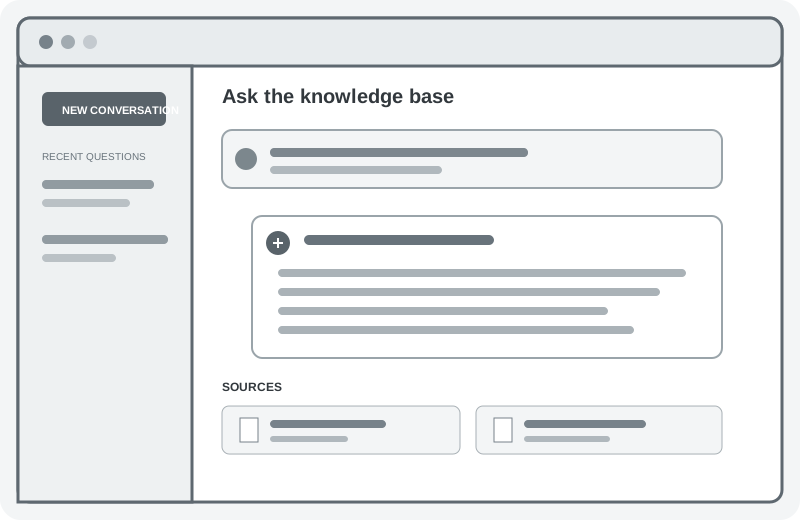
We built an AI knowledge base assistant that searches an organisation’s own documents and returns grounded answers with links to the supporting sources.
Project overview
01 — The brief
Making a private document library easier to use
Important answers often exist somewhere inside policies, guidance, manuals and reference files. The difficulty is finding the right passage quickly and knowing whether an answer can be trusted.
The client needed a private-document question-and-answer system that felt as natural as a conversation while remaining grounded in approved material. Every useful response needed to point users back to the documents that informed it, and the knowledge base had to remain manageable by administrators.
02 — The challenge
Useful AI depends on trustworthy retrieval
The experience had to combine the flexibility of a language model with clear boundaries, traceable evidence and practical document administration.
Grounded answers
Answer from indexed source material and be clear when the available documents do not contain the answer.
Verifiable sources
Connect generated responses to the exact files that support them without exposing unsafe markup or links.
Conversational context
Retain session history so users can ask follow-up questions without repeating the original subject.
Knowledge-base control
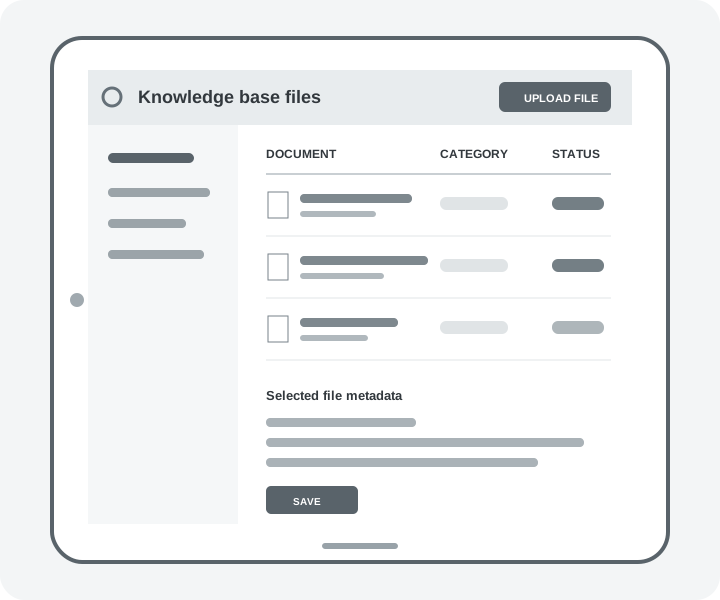
Give administrators a reliable way to upload, categorise, index and manage private documents.
03 — The solution
An assistant built around evidence, not general knowledge
We developed a server-side web application that combines conversational AI with semantic document search. Questions are matched against a private vector index, and the most relevant source material is supplied to the model before it produces an answer.
The same platform provides controlled document upload, metadata management, source-file serving, cached responses and custom rules for query categories requiring pre-approved guidance.
- Answers constrained to indexed source documents
- Inline citations linked to safely served files
- Separate user and knowledge-base management experiences
Private knowledge base
Documents · metadata · vector index
Document upload
Metadata management
Semantic search
Grounded answers
Source citations
Response rules
04 — A typical workflow
From natural-language question to cited answer
Retrieval happens before generation, keeping the response connected to the organisation’s approved material.
-
1
AskThe user submits a question in everyday language.
-
2
SearchThe system searches the private vector store by meaning.
-
3
RetrieveThe most relevant document passages provide context.
-
4
AnswerThe model responds from the retrieved evidence only.
-
5
CiteSource links let the user inspect the supporting files.
05 — Knowledge-base management
Simple administration behind the assistant
Administrators can create or reconnect to a vector store, upload documents and attach useful metadata such as category, description, grouping and upload time. Each file is added to the AI index and retained locally for controlled citation access.
Management screens make indexed files and cached questions visible, helping the team maintain both the source collection and the repeated answers users receive.
06 — Platform capabilities
A complete retrieval-augmented generation application
Conversational Q&A
Support natural questions, contextual follow-ups and a clear new-conversation reset.
Source citations
Link answers to safely encoded document endpoints so users can verify the underlying information.
Document indexing
Upload files, attach rich metadata and manage their relationship with the private vector store.
Answer caching
Normalise and cache initial questions so repeated requests can return quickly and still support follow-ups.
Custom guardrails
Intercept defined sensitive topics and return approved guidance and curated links instead of a generated answer.
Administration
Manage stores, indexed documents, metadata and cached queries through dedicated access-controlled screens.
07 — Technical foundation
A web application connected to AI vector search
The server-rendered application uses a large language model with vector search to manage retrieval and multi-turn answers, supported by a relational database for application records and caching.
Responsive partial-page updates keep the interface fast. Controlled document storage supports secure serving, while output links are sanitised and encoded before rendering.
08 — The outcome
Faster access to answers without losing the source
The completed assistant turns a private document collection into a conversational resource while keeping evidence, administration and response boundaries at the centre of the experience.
Natural discoveryUsers can ask direct questions instead of guessing filenames, folders or exact search terms.
Grounded responsesAnswers are based on retrieved source content and acknowledge when information is unavailable.
Visible evidenceInline citations provide a clear route from each answer back to the supporting documents.
Managed knowledgeAdministrators retain control over indexed files, metadata, cached questions and response rules.
Could your documents work harder?
Let’s make your organisation’s knowledge easier to find and trust.
Tell us what your users need to know. Our initial advice is free.
Talk to us about your project